
The problem isn't staffing, it's ordering
It's 11:47pm. A customer's flight got cancelled, and they need to know whether their travel insurance covers a hotel stay tonight. Support closed six hours ago. So they wait. By morning they've emailed twice more and called once, and whoever opens the inbox first has to piece together what actually happened.
That's not a staffing gap. It's a routing problem, and most support teams still handle it the same way they did a decade ago: everything lands in one queue, in the order it arrived, regardless of what it actually is.
A billing dispute sits behind ten routine order updates. A genuinely upset customer waits behind a dozen people who just want a status check. Nobody chose that order on purpose, it's just how a first-in-first-out inbox works.
Reading the request, not just the queue position
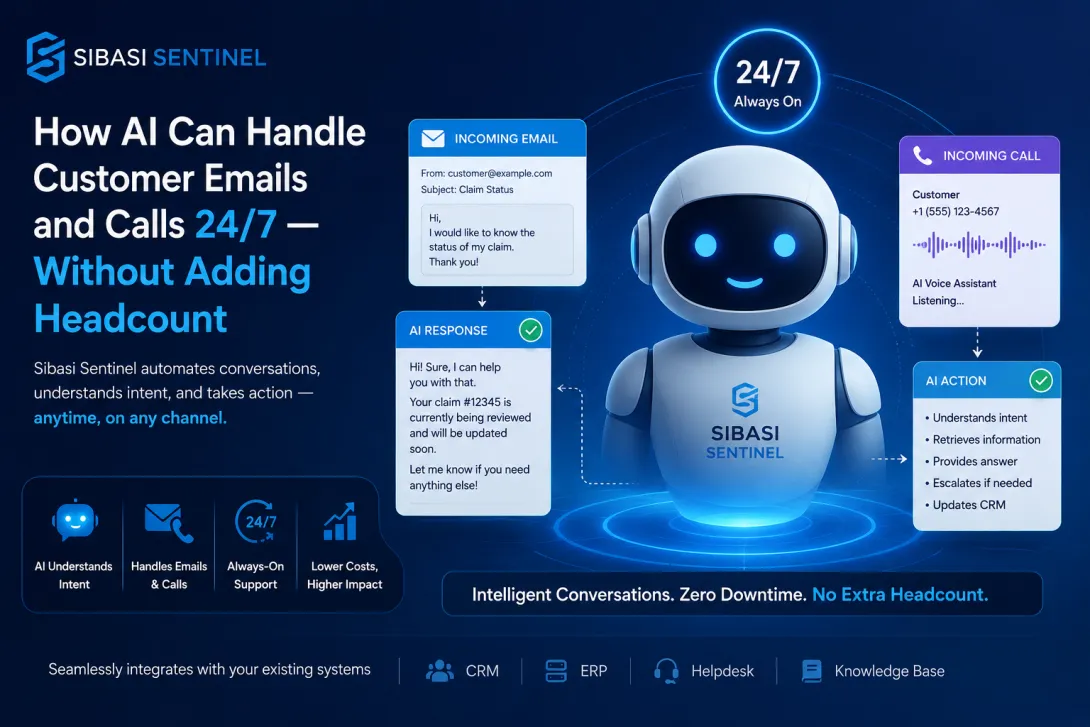
Sibasi Sentinel's Unified Communications module was built to fix that ordering problem, not just speed up typing. It reads incoming emails and calls, works out what's actually being asked and how the person feels about it, and acts on that. Routine requests get handled instantly. Anything that needs judgment goes to a person with full context attached.
A frustrated "this is fine I guess" reads differently than the same words from someone confirming a detail. Sentinel is built to catch that difference, because that's usually the line between a customer who stays and one who doesn't.
For requests that don't need a human at all, a claim status check, an order update, a policy question, Sentinel answers directly, pulling the right record and responding accurately without anyone touching the case. For everything else, it hands off with the full conversation history attached, so the person picking it up isn't starting cold.
A customer emails asking about their claim status. Sentinel reads the request, checks the record, and either replies with the answer or routes it to the right team with context attached. Either way, the customer isn't waiting until someone opens their laptop the next morning.
It doesn't stop once the case is closed
Most support tools go quiet the moment a ticket is marked resolved. Sentinel doesn't have to. Once a claim is settled or a service is delivered, it can follow up on its own, a call or a text asking how things went, whether the issue actually got fixed, whether the customer is satisfied with how they were treated.
That matters for two reasons. First, it catches problems that would otherwise go unreported: a customer who got a technically correct answer but a poor experience rarely emails back to say so, they just quietly stop being a customer. Second, it gives you a record of service quality that didn't come from a survey nobody filled in, but from an actual conversation logged and scored automatically.
If a follow-up surfaces something that went wrong, it gets flagged and routed the same way any other case would be, straight to the person who needs to see it.
Who feels this first
- Insurance desks answering the same claims questions on loop, and following up after a claim closes
- Finance teams buried in routine, repetitive email volume
- Operations teams covering nights and weekends without doubling headcount
None of that requires more people. It requires the inbox to understand what it's looking at before a person ever sees it.
If after-hours gaps or inbox backlog sound familiar, that's worth a conversation.